
Views: 0 Author: Site Editor Publish Time: 2025-09-09 Origin: Site
A cutlery polishing machine is designed to improve the surface finish and appearance of knives, forks, spoons, and other metal utensils. Depending on the machine type, it can be used for industrial cutlery manufacturing or for polishing washed cutlery in commercial kitchens.
An automatic cutlery polishing machine reduces repetitive manual work and helps achieve more consistent finishing results. Industrial systems use abrasive belts, polishing wheels, or other finishing technologies, while commercial cutlery polishers commonly use polishing media to dry utensils and reduce water spots.
This guide explains how cutlery polishing machines work, their main types, benefits, and how to choose suitable equipment for different applications.
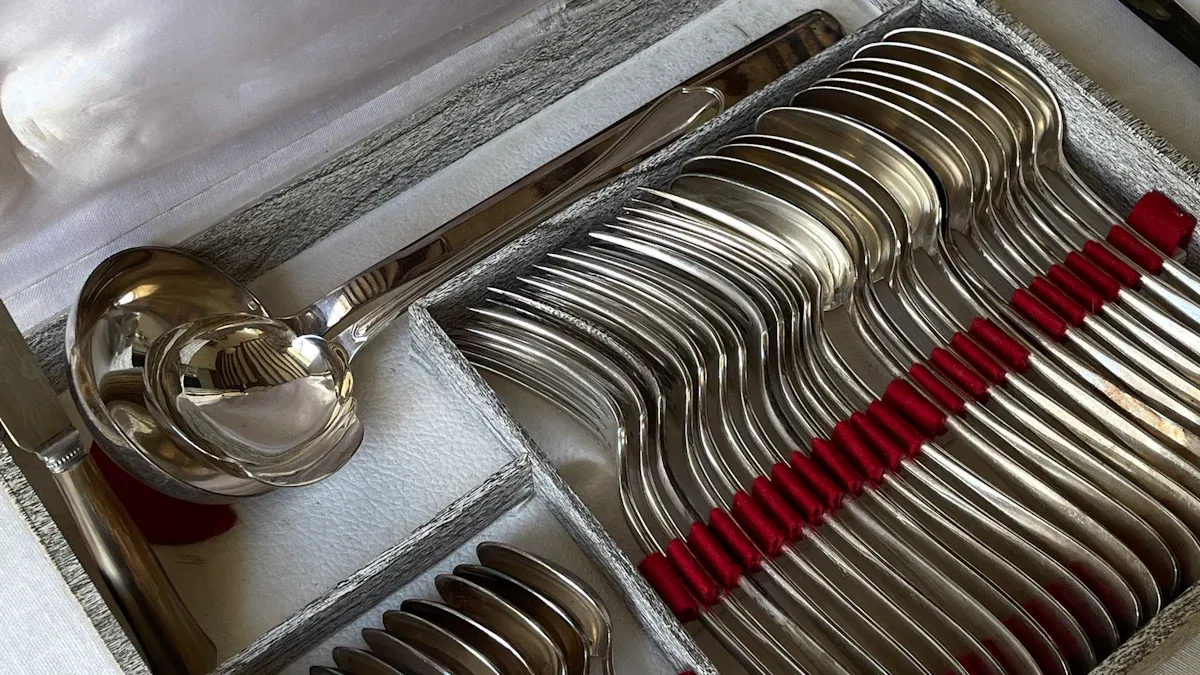
A cutlery polishing machine is equipment designed to improve the surface condition or appearance of metal utensils. However, not all cutlery polishers perform the same function.
Industrial cutlery polishing machines are used during manufacturing to refine stainless steel surfaces, remove finishing marks, and achieve satin or mirror-like finishes. These systems may use abrasive belts, buffing wheels, or automated polishing heads.
Commercial cutlery polishing machines, also called cutlery polishers or silverware polishers, are primarily used in restaurants, hotels, and catering facilities. They help dry and brighten washed utensils, reducing water spots and repetitive manual wiping.
The right equipment depends on whether the goal is manufacturing surface finishing or maintaining the appearance of already-finished cutlery.
A cutlery polishing machine is designed to improve the surface finish and appearance of knives, forks, spoons, and other metal utensils. Depending on the machine type, it can be used for industrial cutlery manufacturing or for polishing washed cutlery in commercial kitchens.
An automatic cutlery polishing machine reduces repetitive manual work and helps achieve more consistent finishing results. Industrial systems use abrasive belts, polishing wheels, or other finishing technologies, while commercial cutlery polishers commonly use polishing media to dry utensils and reduce water spots.
This guide explains how cutlery polishing machines work, their main types, benefits, and how to choose suitable equipment for different applications.
A cutlery polishing machine works by using mechanical movement and finishing materials to improve the appearance of knives, forks, spoons, and other utensils. However, the working process varies depending on whether the machine is designed for industrial manufacturing or commercial kitchen use.
Industrial cutlery polishing machines use abrasive belts, polishing wheels, or buffing compounds to refine stainless steel surfaces during manufacturing. The process typically involves the following steps:
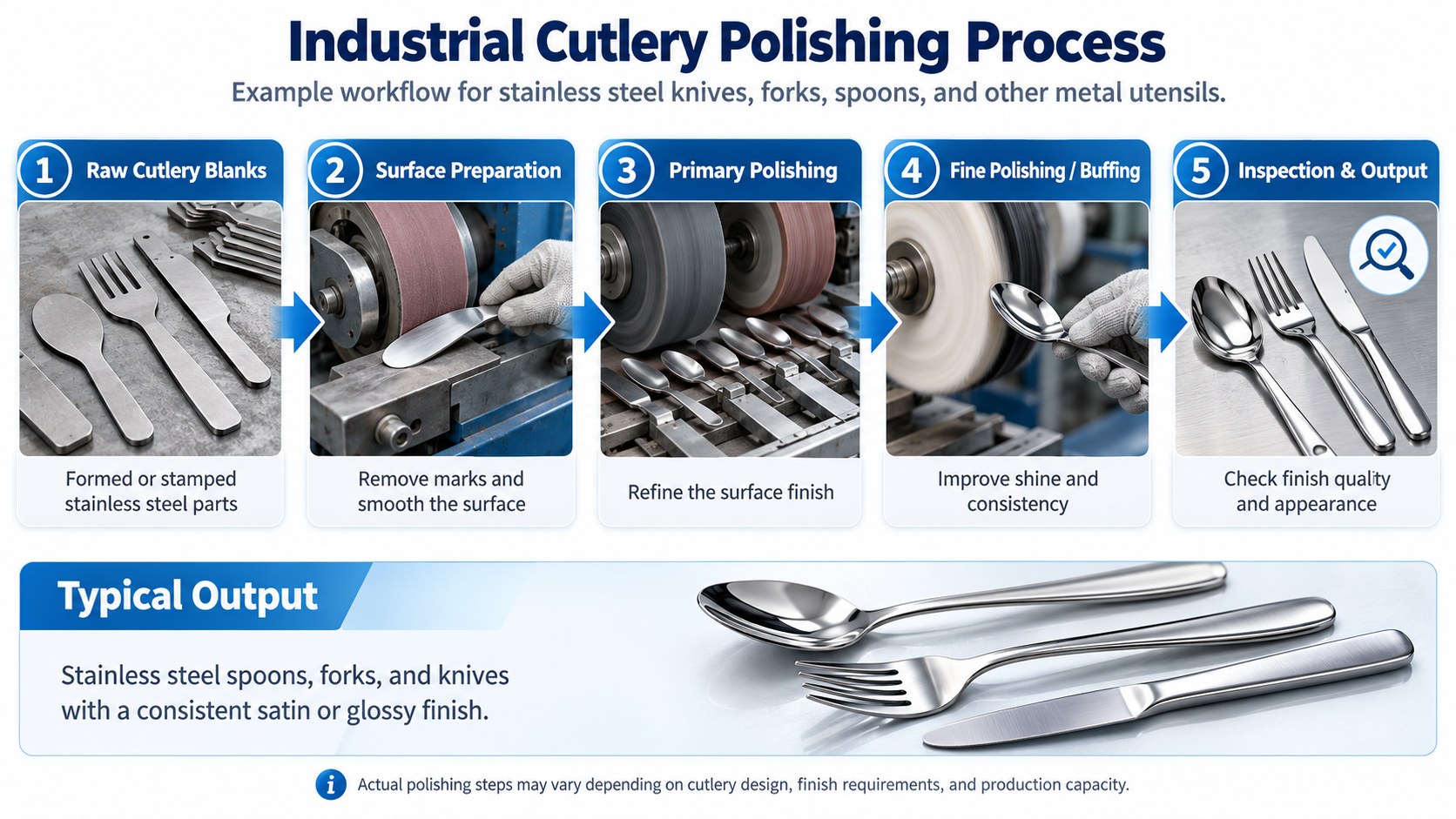
Workpiece Loading: Stainless steel cutlery is positioned or secured for processing.
Surface Preparation: Grinding or sanding removes surface irregularities and visible manufacturing marks where necessary.
Polishing: Polishing wheels or suitable abrasives refine the surface to achieve the required satin or glossy finish.
Final Inspection: Finished cutlery is checked for scratches, uneven polishing, and surface consistency.
The exact operations depend on the cutlery material, shape, and finishing specifications. Automated polishing systems can help improve consistency when processing repeated batches.
Commercial cutlery polishers are commonly used in hotels, restaurants, and catering facilities to dry and brighten washed cutlery. Unlike industrial machines, these systems generally do not perform significant material removal.
Cutlery Loading: Washed cutlery is fed into the machine according to the manufacturer's instructions.
Drying and Polishing: Heated air and polishing media, often corn cob granules, help remove moisture and reduce water spots.
Mechanical Movement: Vibration or other controlled movement allows the polishing media to contact the utensils.
Discharge: Finished cutlery is discharged for inspection and further handling.
Some commercial machines may include additional features such as UV-C treatment, but these are model-specific and should not be treated as standard functions or a replacement for proper washing and sanitation.
Feature | Industrial Polishing | Commercial Polishing |
|---|---|---|
Main Purpose | Surface finishing during manufacturing | Drying and brightening washed cutlery |
Polishing Method | Abrasive belts, wheels, compounds | Polishing media and mechanical movement |
Material Removal | May remove surface material | Generally minimal |
Typical Application | Stainless steel cutlery production | Restaurants, hotels, catering |
Finished Result | Specified surface texture or gloss | Reduced moisture and water spots |
Cutlery polishing machines come in different designs depending on the polishing method, production requirements, and desired surface finish. Some are used in stainless steel cutlery manufacturing, while others are designed to dry and brighten washed utensils in commercial kitchens.
Industrial cutlery polishing machines are used to refine metal surfaces during production. Common finishing technologies include abrasive belt sanding, wheel polishing, and automated polishing systems.
Use abrasive belts to remove manufacturing marks, smooth surfaces, and prepare stainless steel cutlery for further polishing.
Use rotating polishing wheels and suitable compounds to improve surface smoothness and achieve satin or glossy finishes.
Use controlled polishing heads and workpiece positioning systems to improve processing consistency in repetitive production.
Commercial cutlery polishers, also known as silverware polishing machines, are commonly used in hotels, restaurants, and catering facilities. They are designed to reduce moisture and water spots on already-washed cutlery rather than perform heavy surface finishing.
Machine Type | Working Principle | Typical Application |
|---|---|---|
Vibratory Cutlery Polisher | Uses vibration and polishing media to dry and brighten utensils | Restaurants and hotels |
Rotary Drum Polisher | Uses rotating movement and suitable media for finishing or cleaning | Batch finishing applications |
Continuous Cutlery Polisher | Uses a continuous feeding and polishing process | High-throughput catering operations |
The appropriate machine depends on whether the goal is manufacturing surface finishing or maintaining the appearance of washed cutlery.
Manual and automatic cutlery polishing differ in processing speed, surface consistency, labor requirements, and production costs. Manual polishing offers flexibility for small batches and customized finishing, while automatic cutlery polishing machines are generally more suitable for repetitive, high-volume manufacturing.
Feature | Manual Polishing | Automatic Polishing |
|---|---|---|
Processing Speed | Depends on operator skill and workload | More consistent processing cycles |
Surface Finish | Quality varies with operator experience | More repeatable finishing results |
Labor Requirements | Requires continuous manual operation | Reduces repetitive manual work |
Production Capacity | Suitable for small batches | Better suited to repeated, larger batches |
Initial Investment | Generally lower equipment cost | Higher initial equipment investment |
Operating Costs | Labor-intensive for large production volumes | Potentially lower labor cost per part at sufficient volume |
Flexibility | Easier for occasional or customized tasks | Best for compatible, repeatable workpieces |
For small production runs, manual polishing may offer greater flexibility with lower upfront equipment costs. However, manufacturers processing large quantities of stainless steel cutlery can benefit from automatic polishing systems that improve finishing consistency and reduce repetitive manual operations.
The best choice depends on production volume, cutlery design, required surface finish, and total operating costs.
Automatic cutlery polishing machines offer several advantages for manufacturers producing stainless steel knives, forks, spoons, and other metal utensils. By automating repetitive finishing operations, these machines can help improve production efficiency, achieve consistent surface quality, and reduce reliance on manual polishing.
Automatic polishing systems provide repeatable processing cycles, allowing manufacturers to finish larger batches of cutlery more efficiently. With suitable equipment and workpiece handling, automation can reduce processing time and support continuous production.
Controlled polishing pressure, speed, and processing time help achieve more uniform surface finishes across stainless steel cutlery. This is particularly important for products requiring consistent satin or mirror-like appearances.
Automated polishing reduces the need for continuous manual handling and repetitive finishing tasks. Operators can focus more on machine setup, quality inspection, and production monitoring, helping manufacturers manage labor resources more effectively.
Depending on the machine configuration, manufacturers can adjust polishing parameters to accommodate different cutlery shapes, materials, and finishing requirements. Repeatable settings can help reduce variation between production batches.
Although cutlery polishing and cleaning are often associated with each other, they serve different purposes. A cutlery cleaning machine removes food residue, grease, and other contaminants, while a cutlery polishing machine focuses on improving surface appearance and finishing quality.
In industrial manufacturing, polishing refines stainless steel surfaces. In commercial kitchens, cutlery polishers are commonly used after washing to reduce water spots and improve shine.
Feature | Cutlery Cleaning | Cutlery Polishing |
|---|---|---|
Main Purpose | Remove dirt and contaminants | Improve surface appearance |
Typical Equipment | Cutlery washing or cleaning machine | Cutlery polishing machine |
Process | Water, detergents, mechanical washing | Abrasives, polishing wheels, or suitable media |
Main Result | Clean utensils | Smoother or brighter surfaces |
Typical Application | Restaurants, kitchens, manufacturing cleaning stages | Cutlery manufacturing and commercial finishing |
Some commercial systems combine drying and polishing functions, but polishing should not be considered a substitute for proper washing. Industrial cutlery polishing equipment is primarily designed for surface finishing rather than food residue removal or sanitization.
Industrial cutlery polishing machines are used to improve the surface quality and appearance of stainless steel utensils during manufacturing. Different products require different finishing methods depending on their shapes, materials, and desired surface textures.
Stainless steel spoons and forks often require surface grinding, sanding, and polishing to remove manufacturing marks and achieve uniform finishes. Automated polishing systems can help manufacturers maintain consistent satin or mirror-like surfaces across repeated production batches.
Common Processes: Sanding, Polishing, Buffing
Knife handles and other suitable stainless steel surfaces may require grinding and polishing to improve appearance and remove finishing marks. The polishing method should be selected according to the blade geometry, edge requirements, and desired surface finish.
Common Processes: Grinding, Sanding, Polishing
Metal spatulas, serving utensils, and other kitchen accessories often require deburring and polishing after forming or machining. These processes help remove unwanted sharp edges, improve surface consistency, and prepare products for subsequent finishing or inspection.
Common Processes: Deburring, Sanding, Polishing
Stainless steel pots, pans, and cookware components may require grinding, sanding, or polishing to achieve brushed, satin, or glossy finishes. Automated finishing equipment can help process suitable surfaces and improve appearance consistency in cookware manufacturing.
Common Processes: Grinding, Sanding, Polishing
Different cutlery and kitchenware products require different surface finishing solutions. Manufacturers should consider workpiece geometry, material, surface requirements, and production volume when selecting polishing equipment.
Explore Yatai's Cookware & Kitchenware Polishing Solutions to learn more about related industrial metal finishing applications.
Choosing the right cutlery polishing machine depends on the workpiece material, shape, required surface finish, and production capacity. For stainless steel cutlery manufacturers, selecting suitable equipment helps improve polishing consistency, reduce manual operations, and support efficient production.
Stainless steel spoons, forks, and knives have different geometries and finishing requirements. Choose polishing equipment that can accommodate the workpiece dimensions, curved surfaces, and processing areas without damaging functional edges.
Determine whether the product needs a brushed, satin, or mirror-like finish. Abrasive belt systems are commonly used for surface preparation, while polishing wheels and buffing systems are suitable for finer finishing operations.
Evaluate daily output, batch size, processing time, and loading requirements. Automatic cutlery polishing machines may improve consistency in repetitive production, but achievable throughput depends on the machine configuration and workpiece specifications.
Consider polishing consumables, equipment maintenance, energy consumption, and operator requirements. Accessible components and suitable machine controls can help simplify routine maintenance and reduce production interruptions.
Manufacturing Requirement | Suitable Equipment or Process |
|---|---|
Remove forming marks or surface irregularities | Grinding or abrasive belt sanding |
Achieve a smooth, uniform surface | Sanding and intermediate polishing |
Produce satin or mirror-like finishes | Wheel polishing or buffing |
Process repeated batches of similar cutlery | Automatic polishing systems |
Finish complex curved surfaces | Suitable CNC or robotic polishing systems, subject to workpiece compatibility |
The best cutlery polishing solution should match your manufacturing process rather than rely on machine capacity alone. Before selecting equipment, manufacturers should provide workpiece drawings or samples, material specifications, desired surface finish, and estimated production volume.
For related metal finishing equipment, explore Yatai's CNC Polishing Machines and Grinding & Sanding Machines.
During stainless steel cutlery manufacturing, polishing defects can affect surface appearance, finishing consistency, and production quality. Common problems include scratches, uneven finishes, polishing marks, and excessive material removal.
Identifying the causes of these defects helps manufacturers adjust polishing parameters and improve the final surface quality.
Common Problem | Possible Causes | Recommended Solutions |
|---|---|---|
Surface Scratches | Contaminated abrasives, coarse polishing materials, or improper handling | Clean or replace abrasives and use progressively finer finishing materials |
Uneven Polishing Finish | Inconsistent polishing pressure, incorrect workpiece positioning, or irregular contact | Adjust polishing pressure, workpiece fixtures, and processing parameters |
Visible Polishing Marks | Incorrect abrasive sequence or insufficient intermediate finishing | Use an appropriate abrasive progression and refine the surface before final polishing |
Over-Polishing | Excessive pressure, processing time, or unsuitable abrasive selection | Reduce polishing intensity and monitor material removal |
Dull or Inconsistent Shine | Worn polishing wheels, unsuitable compounds, or inconsistent processing conditions | Inspect polishing wheels, select suitable compounds, and maintain consistent settings |
For consistent cutlery polishing results, manufacturers should select suitable abrasives, maintain polishing equipment, and regularly inspect finished surfaces. Testing the polishing process on sample workpieces before full-scale production can help identify suitable settings and reduce finishing defects.
A cutlery polishing machine improves the surface finish and appearance of knives, forks, spoons, and other metal utensils. Industrial machines use abrasive belts or polishing wheels to refine metal surfaces during manufacturing, while commercial cutlery polishers are typically used to dry washed utensils and reduce water spots.
A cutlery cleaning machine removes food residue, grease, and contaminants through washing processes. A cutlery polishing machine focuses on improving surface smoothness or appearance. Commercial polishing machines may also help dry utensils, but polishing does not replace proper cleaning and sanitization.
Many cutlery polishing machines are designed for stainless steel utensils. Some equipment can also process silverware, depending on the polishing method, abrasives, and material compatibility. Silver requires more careful processing to avoid scratches or surface damage. Always verify the machine's suitability before polishing different metals.
An automatic cutlery polishing machine can improve finishing consistency, reduce repetitive manual work, and support efficient batch production. Industrial systems may also provide adjustable polishing parameters for different cutlery shapes and surface requirements. Actual performance depends on the machine configuration and production conditions.
Industrial cutlery polishing machines can reduce fine scratches and surface imperfections using suitable abrasives and polishing processes. Deeper scratches may require grinding or sanding before final polishing. Commercial cutlery polishers are generally designed to reduce water spots and improve appearance rather than remove significant surface scratches.
The polishing materials depend on the equipment type. Industrial cutlery polishing machines may use abrasive belts, buffing wheels, and polishing compounds. Commercial cutlery polishers commonly use polishing granules, such as corn cob media, to help dry and brighten washed utensils.
Consider the cutlery material, workpiece shape, required surface finish, production volume, and equipment maintenance needs. For industrial manufacturing, select a machine based on the polishing process and workpiece compatibility. Automatic systems are generally more suitable for repetitive production requiring consistent finishing results.
Choosing the right cutlery polishing machine depends on the material, required surface finish, and production needs. While commercial cutlery polishers are designed to dry and brighten washed utensils, industrial polishing machines focus on improving surface quality and finishing consistency during manufacturing.
For stainless steel cutlery manufacturers, automatic polishing equipment can help reduce repetitive manual work and support more consistent production results.
Yatai Polishing Machine Co., Ltd. provides industrial grinding, sanding, and polishing equipment for various metalworking applications. Explore our Cookware & Kitchenware Polishing Solutions or contact our team to discuss suitable surface finishing equipment for your manufacturing requirements.


![[O&P] SUS304 SOLID TURNER/ SLOTTED TURNER/ SOUP LADLE/ SKIMMER MIRROR POLISHING | Shopee Malaysia](https://images.openai.com/static-rsc-4/SmZp95Q_kqxm62cEwSGCtSM_gcFyLgBYr6RGJq_J1EYe02gj6qgwfg_PKL6ij63wEfvmASlr4y8WSaa5UK4-6tNfCfyoOBO2Dnuc8ii89Av7lB5nKquaZeG5KG7LtAOKow_CAbxvbQhuaTxcyAH5WEovYBZXz_-8IR-mYbHd7Xs?purpose=inline)


