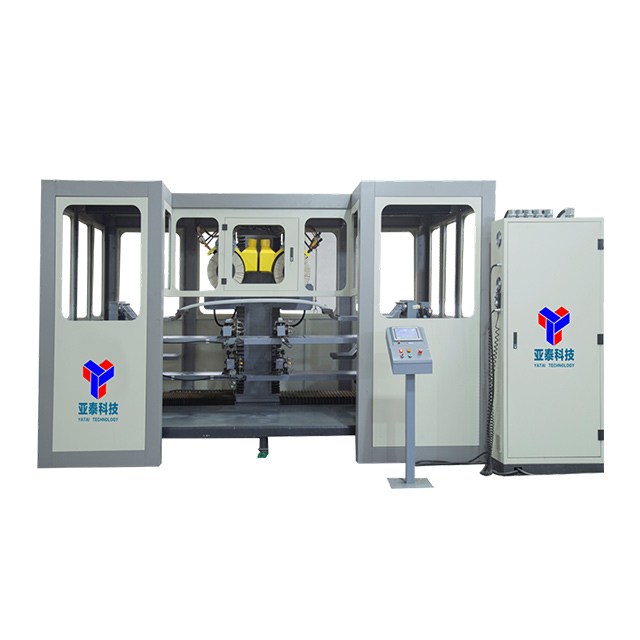
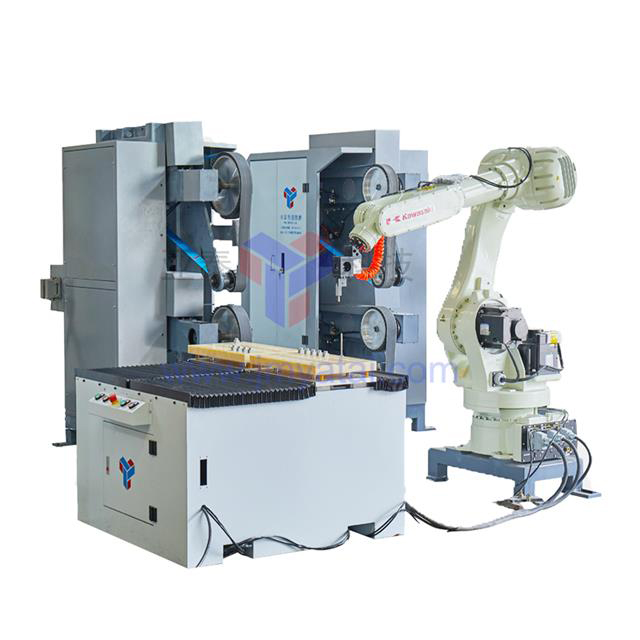
Implementing an automated robot polishing machine is essential for sanitary ware manufacturers seeking to eliminate the high-variance bottlenecks and health hazards of manual faucet finishing. By utilizing 6-axis kinematic flexibility paired with closed-loop active force control, these advanced workstations maintain deterministic contact pressure across complex, non-symmetrical brass and zinc geometries. This automation optimizes cycle times, guarantees uniform surface roughness ($R_a < 0.05\,\mu\text{m}$) required for flawless plating, and slashes component scrap rates. Integrating these systems from an industry-leading surface treatment pioneer like Yatai ensures rapid offline programming changeovers and strict environmental safety compliance.
Integrating an automatic deburring machine into high-volume die casting workflows is a vital step toward resolving manual finishing bottlenecks and cutting scrap rates. By transitioning from hand tools to specialized robotic compliance cells, rigid CNC spindles, or mass vibratory systems, facilities stabilize their cycle times and achieve highly consistent edge quality. These automated solutions systematically isolate operators from ergonomic strain while ensuring flawless parting line execution across complex aluminum, zinc, and magnesium alloys. Investing in turnkey post-cast automation from a globally recognized finishing leader like Yatai protects profit margins and guarantees assembly readiness at scale.