You can make 150% more products with the right tools. A faucet maker in Vietnam did this by using a Faucet Polishing Machine. This machine helped them make more faucets. It also made their work faster and better. If you want to make your factory better, this story can help you get ideas.
Key Takeaways
Challenges Faced
Manual Polishing Issues
Manual polishing causes many problems for making faucets. Workers must polish each faucet by hand. This means results are not always the same. Each worker uses different pressure and angles. Workers get tired after a long time. This makes the finish even more uneven. Some problems you might see are:
The finish looks different because workers get tired or use different methods.
You have to redo or throw away more parts, which costs more money.
It is hard to make parts that meet strict rules.
There is a bigger chance of breaking parts or workers getting hurt.
More time is needed to check for mistakes.
Later steps, like anodizing, can fail and make you throw away more parts.
Manual polishing makes quality less reliable and slows down work. It is hard to keep high standards. Customers are not happy when products are not good.
Production Bottlenecks
Manual polishing also slows down how fast you can work. Each faucet needs to be polished one at a time. This makes the line move slowly. Faucets with tricky shapes take even longer. You need skilled workers for these jobs. Paying workers costs more money. Making more faucets is hard. Workers can get hurt or sick from dust or doing the same thing over and over. This makes them work less and miss days.
Here is a table that compares manual and automated polishing:
Aspect | Manual Polishing | Automated Polishing |
Labor Intensity | Needs skilled workers, who get tired | Robots do most of the work |
Production Rate | Slow and not steady | Can make up to 6,000 parts each hour |
Operation Time | Workers get tired and lose focus | Can run for hours without stopping |
Consistency | Finish changes a lot | Finish is always the same |
Safety | Workers breathe dust and face dangers | Machines keep workers safer |
Manual polishing makes work slower, lowers output, and costs more. It is hard to meet orders and keep quality high. This makes it tough to grow your business.
Faucet Polishing Machine Solution
Why Automation
You want to make more faucets in less time. Manual polishing slows you down and makes your products look different each time. Automation gives you a way to solve these problems. When you use a Faucet Polishing Machine, you get steady results. Machines do not get tired or make mistakes from fatigue. You can run your production line longer and keep the quality high. Many factories choose automation to meet bigger orders and keep customers happy.
Tip: Automation helps you keep up with market demand and stay ahead of your competitors.
Selection Process
Choosing the right machine matters. You need to look at your production needs first. Think about how many faucets you want to polish each day. Check the shapes and sizes of your products. Some machines work better for simple designs, while others handle complex shapes. You should also look at the machine’s speed, safety features, and how easy it is to use. Ask for a demo or visit a factory that uses the machine. This helps you see how it works in real life.
Here is a checklist to guide your selection:
Daily output requirements
Product shapes and sizes
Machine speed and efficiency
Safety features
Ease of operation and maintenance
Implementation Steps
You need a clear plan to add a Faucet Polishing Machine to your factory. Start by training your team. Show them how to use the new machine safely. Next, set up the machine in your production line. Test it with a small batch of faucets. Check the finish and make sure it meets your standards. Adjust the settings if needed. Once you feel confident, increase the number of faucets you polish each day. Keep track of your results and look for ways to improve even more.
Integration and Operation
Machine Workflow
You can set up your Faucet Polishing Machine to fit your production line. First, you load the unpolished faucets onto the machine’s conveyor. The machine uses robotic arms to grip each faucet. Next, the polishing heads move over the surface. They follow a programmed path to make sure every part gets the same finish. The machine uses sensors to check the pressure and speed. This helps you get a smooth and shiny surface every time.
You can adjust the settings for different faucet shapes. The control panel lets you pick the right program for each batch. When the cycle ends, the machine places the polished faucets onto the output tray. You can then move them to the next step in your process.
Tip: Regularly check the polishing heads and sensors. This keeps your workflow smooth and your results consistent.
Overcoming Obstacles
You may face some challenges when you first use the machine. Training your team is important. Make sure everyone knows how to operate the controls and handle the faucets safely. Sometimes, you might need to fine-tune the settings for new faucet designs. Keep a log of any changes you make. This helps you solve problems faster in the future.
If you notice uneven finishes, check the polishing heads for wear. Replace them when needed. You should also keep the machine clean to avoid dust buildup. This protects both the machine and your products.
Here is a quick checklist to help you overcome common obstacles:
Train all operators on safety and controls
Adjust settings for each faucet type
Inspect and replace worn parts
Clean the machine after each shift
Keep a maintenance log
By following these steps, you can keep your production running smoothly and get the most from your investment.
Results Achieved
Output Increase
After using the Faucet Polishing Machine, production numbers went up a lot. The Vietnamese faucet maker made 150% more faucets. Now, you can finish orders much faster. The machine works longer without stopping. You do not have to wait for workers to take breaks. You can polish up to 6,000 parts every hour. This helps you finish big orders on time. Your factory can grow and take on more work.
Quality Improvements
Product quality got much better. The machine gives each faucet a smooth finish. You do not have to worry about rough spots or missed areas. Every faucet looks the same. There are fewer mistakes and less waste. You can meet strict rules and keep customers happy.
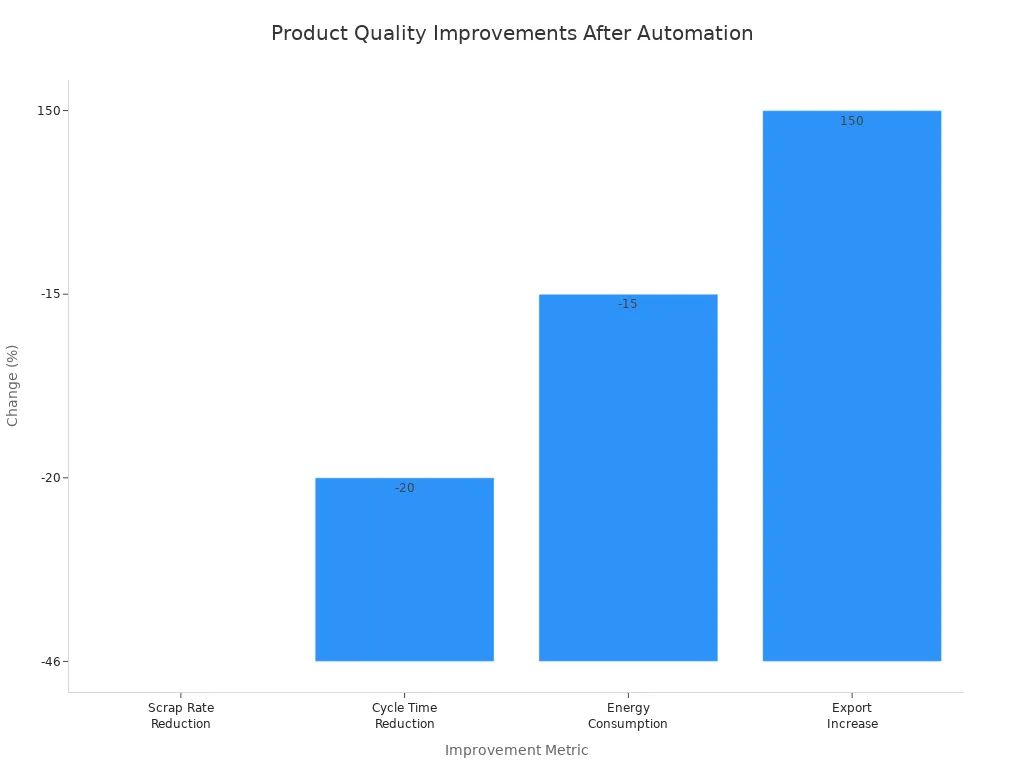
Here is a table that shows how things improved after automation:
Improvement Metric | Measurable Result |
Scrap Rate Reduction | 46% decrease at CEAT India |
Cycle Time Reduction | 20% decrease |
Energy Consumption | 15% decrease |
Export Increase | 2.5 times increase |
You can also see these changes in the chart below:
Automation and real-time checks help you find mistakes early. You throw away less and make more good products. You can use machine data to fix problems fast. This keeps your line moving and your faucets looking great.
Cost and Labor Savings
You save money in many ways with automation. You need fewer people for polishing. You can move workers to other jobs. You spend less on training and overtime. The machine uses less energy, so bills go down. Some factories saved up to $300,000 in five years by automating checks.
You also throw away fewer parts. Fewer mistakes mean less waste. You ship more good faucets and keep costs low. Customers get better products.
Note: Automation helps you need fewer workers and makes things safer. Your team works in a cleaner place with less dust and fewer boring jobs.
Lessons for Manufacturers
Key Takeaways
You can learn many important lessons from this success story. Automation brings big changes to your factory. Here are some key points to remember:
Automation improves quality and keeps your products consistent. Machines reduce human mistakes and make every part look the same.
Robots and sensors help you work faster. You can meet tight deadlines and handle more orders.
You save money by using resources better and making less waste.
Start automation in steps. This helps you avoid problems and keep your factory running smoothly.
Train your team often. Workers need to learn new skills to use new machines.
Look for new trends like AI and eco-friendly tools. These help you stay ahead in the market.
Automation works in many industries, not just metal. You can find new ways to grow and improve.
Remember: Automation does not just replace jobs. It creates new roles and helps your team learn new skills.
Tips for Success
You can make your automation project a success by following some simple tips:
Begin with easy, repeatable tasks. This helps you see quick results and builds trust in automation.
Remove burrs and flashes before polishing. Use a wheel grinding machine for large burrs.
Use ceramic media for the first round of burr removal. This step usually takes about two hours.
Smooth the surface with plastic tumbling media for another two hours. This prepares the part for the next steps.
Finish with zirconia ball media for 20–30 minutes. This gives your parts a bright, shiny look.
Pick the right media shape and size. Cone-shaped media around 20–25 mm works well and prevents parts from getting stuck.
Recycle smaller media for simple parts. This saves money and reduces waste.
Choose a round vibratory finishing machine without a separation deck. This protects soft materials from damage.
Install a speed converter to slow down the machine when collecting parts.
Dry parts right after wet finishing. This stops rust, especially on zinc parts.
Tip: Always follow each surface treatment step carefully. Clean, dry, and prepare every part before polishing for the best results.
You can make your factory work better with a Faucet Polishing Machine. Many companies, like Delta Faucet, have made big improvements by using machines. You can make more faucets and get better quality. Your workplace will be safer for everyone. These good results happen for many factories. You can do the same and get great results too. Think about using automation to help your business grow and stay strong against others.
FAQ
What types of faucets can you polish with this machine?
You can polish many types of faucets, including brass, zinc, and stainless steel. The machine adjusts to different shapes and sizes. You get a smooth finish every time.
How long does it take to train workers to use the machine?
Most workers learn basic operation in one day. Full training takes about one week. You can use the control panel easily. The machine comes with clear instructions.
Can you use the machine for other metal parts?
Yes! You can polish handles, knobs, and other metal parts. The machine works well for many products in the hardware industry.
What maintenance does the machine need?
Clean the machine after each shift.
Check and replace polishing heads when needed.
Keep a maintenance log.
Inspect sensors regularly.
Regular care keeps your machine running smoothly and extends its life.