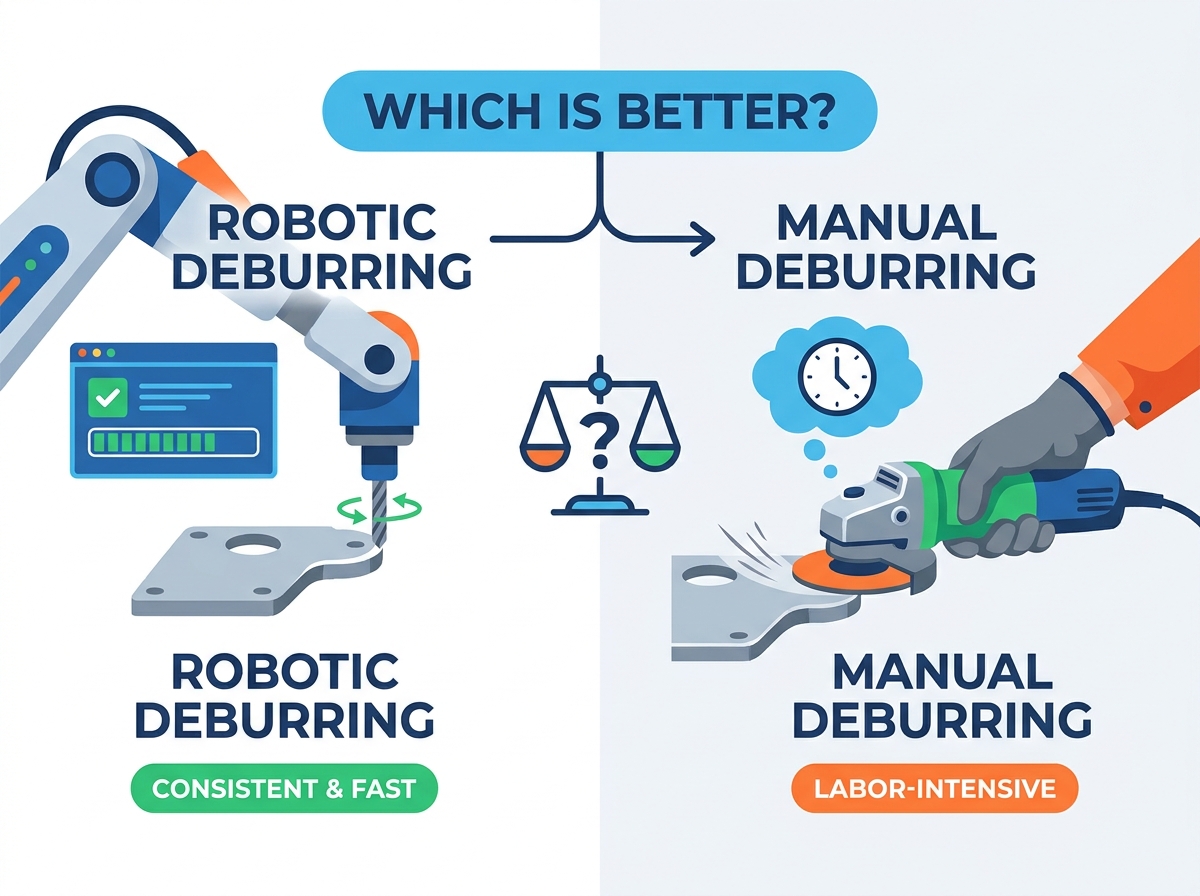
Material removal and surface finishing remain major bottlenecks in modern manufacturing facilities. These processes dictate final part quality, downstream reliability, and overall production cadence on the shop floor. Machining operations consistently generate burrs across various materials. Relying on traditional hand-finishing introduces variables in cycle times, scrap rates, and labor availability. Conversely, automation requires upfront capital and integration expertise. Evaluating robotic vs manual deburring requires moving beyond generic claims of faster production. You must conduct a rigorous analysis of part mix, tolerance requirements, and workforce safety. This evaluation directly impacts your facility's operational efficiency and throughput. We will explore the mechanical realities, hidden costs, and implementation strategies for both methods. This analysis provides the technical foundation needed to optimize your surface finishing operations and reduce scrap.
Volume and Mix Dictate the Choice: Manual deburring remains the most cost-effective solution for high-mix, low-volume (HMLV) environments, while robotic deburring excels in low-mix, high-volume (LMHV) production where programming time is amortized.
Consistency Outweighs Raw Speed: The primary ROI driver for automated material removal is often the drastic reduction in scrap rates and rework caused by human inconsistency, rather than cycle time reduction alone.
Downstream Reliability: Automated deburring eliminates the variance that leads to assembly problems, fluid leaks, premature wear, and unpredictable adhesive bonding.
Ergonomics and Labor Constraints: Automating deburring directly mitigates repetitive strain injuries (RSIs) and respiratory hazards, addressing severe labor shortages in skilled finishing roles.
Force Compliance is the Differentiator: Modern robotic deburring relies on active or passive force control to mimic human touch, ensuring uniform material removal even when part castings or machining tolerances vary.
Defining the Baseline: The Realities of Manual Deburring
Where Manual Processes Excel
Human operators bring unmatched flexibility to the shop floor. They adapt instantly to custom orders and one-off prototypes without missing a beat. Hand finishing handles highly complex and unpredictable geometries effortlessly. Operators use tactile feedback to navigate intricate internal bores and intersecting cross-holes. They feel the burr roll off the edge and adjust their pressure instinctively. Job shops dealing with constant changeovers benefit heavily from zero programming time. You simply hand an operator a part and a pneumatic die grinder. Production begins immediately without software simulation delays or dry runs. This method features a very low barrier to entry. Capital expenditure remains minimal for manual operations. Facilities only need to purchase hand tools, abrasive pads, and basic personal protective equipment. You avoid complex integration phases entirely. Manual deburring remains highly effective for low-volume aerospace components or custom automotive parts. The human eye easily detects surface anomalies that basic sensors might miss. Operators can switch between different materials and tool types in seconds. They grab a carbide burr for steel and switch to a Scotch-Brite wheel for aluminum instantly.
Skilled machinists develop a muscle memory that machines struggle to replicate without extensive programming. For example, when deburring a fragile aluminum aerospace bracket, a human operator knows exactly how much pressure to apply to avoid altering the critical dimensions. They can visually inspect the part while working, identifying and fixing minor machining defects on the fly. This simultaneous inspection and finishing process saves time in low-volume production runs. Furthermore, manual deburring stations require virtually zero facility modifications. You do not need to pour reinforced concrete pads or install heavy-duty electrical drops. A standard workbench, a vise, and a compressed air line are usually sufficient to get a manual station running.
The Hidden Costs of Hand Deburring
Manual deburring carries significant hidden operational costs that eat into margins. Operator fatigue directly impacts part-to-part consistency over a standard shift. Tired workers apply uneven pressure during their afternoon hours. This leads to over-chamfering, deep gouging, or entirely missed burrs. High scrap rates create a severe operational drag on production schedules. Ruining a high-value titanium casting due to a slipped hand grinder destroys profit margins for that entire batch. Inconsistent edge breaks cause catastrophic downstream failures. Sharp burrs slice O-rings during hydraulic assembly. Loose metal flakes contaminate enclosed fluidic systems and destroy pumps. Poor surface preparation ruins adhesive bonding integrity on composite structures. Furthermore, hand finishing introduces severe workplace hazards. Prolonged exposure to vibrating hand tools causes vibration white finger. Repetitive motions lead to debilitating carpal tunnel syndrome. Inhaling metal particulates creates long-term respiratory liabilities for your workforce. These indirect medical and scrap costs rapidly inflate operational budgets. You spend more time reworking bad parts than producing good ones.
Consider the impact of a single missed burr on a hydraulic manifold. If that burr breaks loose during operation, it travels through the fluid lines, scoring cylinder walls and destroying expensive proportional valves. The cost of that failure far exceeds the hourly wage of the operator who missed it. Additionally, the physical toll on workers leads to high turnover rates in finishing departments. Finding personnel willing to grind metal for eight hours a day is becoming increasingly difficult. When experienced operators leave, they take their specialized knowledge with them, forcing you to spend weeks training replacements. During this training period, scrap rates inevitably spike as new workers learn the required techniques.
The Mechanics of Robotic Deburring Systems
Core Architecture of a Deburring Cell
A standard automated deburring cell relies on several integrated components working together. The foundation is a heavy-duty 6-axis robotic arm. This arm provides the necessary articulation to reach complex part angles and internal cavities. Specialized end-of-arm tooling holds the cutting media securely. High-speed spindle motors drive the abrasive wheels or carbide burrs. These spindles often operate between ten thousand and forty thousand revolutions per minute. Facilities typically deploy one of two primary configurations based on part size. Part-to-tool setups involve the robot gripping the workpiece directly. The arm presents the part to a stationary abrasive belt or pedestal motor. Tool-to-part configurations reverse this physical dynamic. The robot manipulates the spindle and cutting tool around a heavy, stationary casting. Each architecture serves specific payload and geometry requirements. Heavy cast iron engine blocks require tool-to-part setups because the robot cannot lift them easily. Small, lightweight aluminum medical implants utilize part-to-tool configurations for better cycle efficiency and easier material handling.
The choice of abrasive media also plays a massive role in cell design. Automated systems utilize everything from aggressive carbide rotary files for heavy slag removal to fine nylon abrasive brushes for edge radiusing. The robotic arm must possess the rigidity to handle the aggressive vibration generated by these tools. Without sufficient stiffness, the robot arm will deflect, causing chatter marks on the workpiece. Integrators often specify heavy-duty foundry-grade robots for these applications. These specialized robots feature IP67 ratings, protecting their internal gears and motors from the highly abrasive metallic dust generated during the cutting process.
The Role of Force Compliance Systems
Force compliance represents the most significant technological leap in automated finishing. These systems allow the robot to maintain constant pressure against the workpiece. Rigid robotic paths often fail when processing cast parts with dimensional variations. Active force compliance uses load cells and software to adjust pressure dynamically. The system reads resistance and modifies the tool position in milliseconds. Passive systems rely on pneumatic cylinders or mechanical springs built into the tool holder. Both methods compensate for slight variations in base material dimensions. They also adjust automatically for gradual abrasive tool wear during operation. This technology effectively replicates the tactile feedback of a human operator. It prevents the robot from cutting too deeply into the base material. Force compliance eliminates the chatter marks commonly associated with rigid automated grinding. You get a smooth, consistent finish regardless of minor casting shifts.
Without force compliance, a robot follows a rigid mathematical path. If a cast iron part is slightly oversized due to mold wear, a rigid robot will plunge the tool too deeply, ruining the part and potentially snapping the spindle. Active force compliance prevents this by acting as a shock absorber. It constantly monitors the torque and resistance encountered by the tool. If the resistance spikes, the system instantly pulls the tool back a fraction of a millimeter. This dynamic adjustment ensures a uniform edge break along the entire profile of the part, regardless of minor dimensional inconsistencies.
Vision Systems and Path Generation
Modern deburring cells utilize advanced 3D vision systems to guide the cutting tools. Cameras and structured light scanners map the exact physical dimensions of each part. This spatial data feeds directly into offline programming software. Engineers generate precise toolpaths without tying up the physical machine on the floor. Offline programming maximizes production uptime and keeps the spindle turning. The software identifies edge deviations before the cutting tool engages the material. This integration allows robots to process complex contours with extreme accuracy. The software imports standard CAD files to generate precise cutting trajectories. It automatically calculates the optimal approach angles for the spindle. This prevents tool collisions and ensures uniform material removal across complex intersecting geometries. You eliminate the trial-and-error approach of manual teach pendant programming.
These vision systems also handle part localization. In a manual setup, an operator visually aligns the part. In an automated cell, the robot must know exactly where the part sits in space. 3D cameras scan the part in the fixture and compare its actual position to the theoretical CAD model. The software then shifts the entire cutting program to match the physical reality. This eliminates the need for ultra-precise, expensive mechanical fixtures. You can drop a part into a basic nest, and the vision system compensates for any slight misalignment before the spindle even powers up.
Robotic vs Manual Deburring: Core Evaluation Dimensions
Throughput and Cycle Time Analysis
Robots operate continuously without physical fatigue or mental distraction. They enable true lights-out manufacturing across multiple production shifts. Human workers require variable pacing, mandatory breaks, and shift changeovers. Robotic cycle times may not always be faster per individual part. Complex geometries sometimes require slower automated feed rates to maintain finish quality. However, overall facility throughput increases dramatically with automation. Zero fatigue means the machine produces parts at a constant, predictable cadence. You eliminate the afternoon productivity slump entirely. Automated cells maintain high overall equipment effectiveness throughout the entire week. This predictability allows plant managers to schedule downstream assembly operations with absolute certainty. Continuous uptime heavily outweighs minor per-part speed advantages found in manual hand routing. You get more good parts in the bin at the end of the week.
Consider a facility running three shifts. A manual operator might spend 15% of their shift on breaks, tool changes, and material handling. Over a week, that equates to hours of lost spindle time. A robot, however, transitions from part to part in seconds. It does not stop to stretch or check its phone. This relentless consistency allows production planners to optimize their supply chain. When you know exactly how many parts the deburring cell will output per hour, you can reduce work-in-progress inventory. You no longer need to stockpile unfinished parts as a buffer against variable manual finishing rates.
Quality, Consistency, and Tolerance Control
Robotic systems hold exceptionally tight tolerances consistently. They meet strict aerospace and medical device standards across thousands of consecutive cycles. This robotic consistency ensures highly predictable surface finishes. Reliable finishes are mandatory for proper industrial coating adhesion. They also ensure tight-tolerance sealing in high-pressure fluid systems. Manual deburring suffers from natural human physical variance. Finishing quality depends heavily on the individual operator's daily skill level. An operator's fatigue level directly alters the final part dimensions. A robot applies the exact same force on the first part and the thousandth part. This repeatability drastically improves your process capability index. Downstream automated assembly machines require uniform parts to function without jamming. Robotic edge breaking guarantees this necessary uniformity.
In industries like medical device manufacturing, surface finish dictates product viability. A titanium bone plate must have perfectly smooth edges to prevent tissue irritation. Manual deburring introduces the risk of micro-gouges, which can harbor bacteria or create stress risers that lead to component failure. Robotic systems eliminate this risk by maintaining a constant feed rate and tool angle. The resulting surface finish is mathematically predictable. This level of control simplifies the quality assurance process. Inspectors spend less time measuring edge breaks because the robotic process is inherently stable and repeatable.
Flexibility and Changeover Speed
Changeovers highlight a significant operational difference between the two methods. Manual deburring requires minimal friction during a production changeover. You just give the operator new physical instructions and a different part. Automated systems require structured programming, physical simulation, and dry-run testing. For custom or low-volume orders, programming often takes longer than hand finishing. You must align fixtures and verify tool center points. However, modern CAD-to-path software actively reduces this changeover friction. Engineers can now generate automated toolpaths in minutes rather than hours. Software automatically extracts edge data from imported solid models. This rapid path generation makes automation viable for medium-mix environments. Yet, manual finishing still dominates ultra-low volume job shop scenarios where parts change daily.
To bridge the gap between manual flexibility and robotic consistency, many shops utilize parametric programming. Instead of programming every single toolpath from scratch, engineers create master templates for families of parts. When a new part size is introduced, they simply update the dimensional parameters in the software. The system automatically scales the toolpaths to fit the new geometry. This approach drastically reduces changeover times for manufacturers dealing with variations of a core product design. However, if a shop receives a completely unique, one-off prototype, handing it to a skilled manual operator remains the most efficient path to completion.
Evaluation Dimension
Manual Deburring
Robotic Deburring
Initial Setup Time
Immediate. Requires only basic hand tools and brief operator instruction.
Moderate to High. Requires offline programming, fixture alignment, and safety validation.
Part Consistency
Variable. Highly dependent on operator skill, fatigue, and shift timing.
Exceptional. Delivers identical surface finishes and edge breaks across thousands of cycles.
Overall Throughput
Limited by human endurance, mandatory breaks, and shift changes.
High. Capable of continuous, lights-out manufacturing with zero fatigue.
Flexibility
Maximum. Operators adapt instantly to new geometries or custom prototypes.
Improving. Modern CAD-to-path software speeds up changeovers, but still requires structured programming.
Safety Profile
Poor. High risk of repetitive strain injuries, lacerations, and respiratory issues.
Excellent. Removes humans from hazardous environments and eliminates ergonomic strain.
Cost Analysis and ROI Modeling
CapEx vs. OpEx Considerations
Evaluating these methods requires analyzing capital versus operational expenses. A robotic cell demands a significant initial capital investment. You must purchase the robot arm, safety enclosures, integration services, and specialized tooling. Manual labor relies entirely on ongoing operational expenses. These include hourly wages, healthcare benefits, and constant turnover costs. Manual finishing also generates higher abrasive consumable waste due to uneven application. Liability claims from repetitive strain injuries add unpredictable operational expenses to manual processes. Automation shifts the financial burden from variable labor to fixed physical assets. This transition stabilizes your long-term production forecasting. You eliminate the constant cost of recruiting and training new finishing operators. Fixed robotic assets depreciate predictably over their operational lifespan.
When analyzing operational expenses, you must also factor in the cost of consumables. Human operators tend to wear out abrasive pads unevenly, often discarding them before they are fully depleted. Robots apply consistent pressure and utilize the entire cutting surface of the tool, extending consumable life significantly. Furthermore, the reduction in liability insurance premiums can be substantial. By removing workers from a high-risk ergonomic environment, facilities often see a decrease in workers' compensation claims. These indirect savings accumulate rapidly, offsetting the initial capital expenditure of the robotic hardware.
Calculating the Break-Even Point
Calculating your return on investment requires a structured financial framework. You must measure direct labor displacement and significant scrap reduction. Factor in the increased throughput and subsequent revenue generation. Include the reduced abrasive consumable costs in your calculations. Robots optimize tool life far better than humans do by applying consistent pressure. Most manufacturing facilities see a fast return on investment. A fully utilized deburring cell typically breaks even within twelve to twenty-four months. Multi-shift operations achieve this financial milestone even faster. You must also account for the reduction in downstream warranty claims. Eliminating burr-related field failures saves significant post-production capital. Accurate ROI modeling requires tracking current manual rework hours meticulously.
A comprehensive ROI model must capture the cost of poor quality. If manual deburring results in a 5% scrap rate on parts that have already accumulated significant machining value, the financial loss is staggering. By dropping that scrap rate to near zero, the robotic cell pays for itself through material and machining time savings alone. You should also calculate the opportunity cost of your labor force. When you automate the deburring process, you free up skilled workers to perform higher-value tasks, such as operating CNC mills or performing complex assemblies. This labor reallocation boosts the overall productivity of your entire facility.
Implementation Risks and Mitigation Strategies
Programming Complexity and Skill Gaps
Existing manufacturing staff often lack advanced robotics programming expertise. This technical skill gap poses a significant implementation risk. Managing a complex deburring cell requires specialized kinematic knowledge. You can mitigate this by investing in intuitive offline programming software. Secure comprehensive training directly from your chosen systems integrator. Modern software platforms feature highly user-friendly graphic interfaces. They lower the technical barrier for your existing manufacturing engineers. You no longer need to write raw code line by line. Operators use visual tools to select edges and define cutting parameters. This transition empowers your current workforce to manage advanced automation effectively.
The fear of complex programming often deters smaller manufacturers from adopting automation. However, the industry has shifted away from proprietary, code-heavy programming languages. Modern interfaces resemble standard CAD software, making them intuitive for anyone with basic machining knowledge. Many integrators also offer remote diagnostics and support. If your team encounters a programming hurdle, the integrator can log into the cell remotely, identify the issue, and push a software update within minutes. This level of support minimizes downtime and builds confidence among your internal engineering staff as they learn the new system.
Tool Wear and Maintenance Downtime
Automated systems cannot instinctively swap a worn abrasive pad. A human operator feels exactly when a tool stops cutting effectively. Unmonitored robots will continue running, potentially producing out-of-spec parts. Mitigate this mechanical risk by implementing automated tool changers. Utilize tool wear compensation software to adjust cutting paths automatically. Establish strict, routine maintenance schedules for all high-speed spindle motors. Implement current sensors on the spindle to detect dull tools. When the spindle draws more amperage to maintain speed, the tool is dull. The system can then automatically trigger a tool change routine. This prevents surface gouging and maintains strict tolerance control.
To further optimize maintenance, facilities implement predictive monitoring systems. These systems track the vibration signatures of the spindle motors over time. If a bearing begins to fail, the vibration profile changes slightly. The software detects this anomaly and alerts the maintenance team before a catastrophic failure occurs. This allows you to schedule spindle replacements during planned downtime, rather than suffering an unexpected breakdown in the middle of a critical production run. Proper maintenance of the robotic cell ensures it continues to deliver the precision and consistency required for high-quality surface finishing.
Facility Footprint and Safety Integration
Industrial robots require significant dedicated floor space. You must install rigid safety fencing, interlocked access doors, and light curtains. Physical space constraints can easily derail an automation project. Conduct a rigorous spatial audit prior to purchasing any equipment. Map out the exact footprint required for safe operator loading zones. Consider collaborative robots for lighter deburring tasks. Cobots require less safety infrastructure if floor space is strictly limited. They utilize built-in force sensors to stop safely upon human contact. However, note the strict trade-off in payload capacity and material removal speed. Traditional industrial robots remain necessary for heavy grinding on hardened steel castings.
Safety integration goes beyond just erecting fences. You must design the cell to facilitate safe and efficient material loading. Many cells utilize rotary index tables. The operator loads raw parts on one side of the table, outside the safety zone, while the robot deburrs parts on the inside. Once the cycle is complete, the table rotates, swapping the finished parts for the raw ones. This setup keeps the operator completely isolated from the robotic hazards while ensuring the robot never has to wait for material. It maximizes spindle uptime while maintaining strict compliance with industrial safety standards.
Conclusion
The choice between these finishing methods is not a simple binary assessment. It requires strategic alignment with your production volume and part mix. You must evaluate your specific quality requirements and tolerance thresholds. Stick with manual deburring if your operation is highly customized. Low-volume job shops often lack the capital for heavy automation infrastructure. Transition to automated systems if you suffer from high daily scrap rates. Automate if you struggle to staff dirty, dull finishing departments. Invest in robotics to eliminate downstream assembly issues caused by inconsistent edge breaks. Automation stabilizes your production cadence and protects your workforce from ergonomic hazards.
Follow these next steps to refine your surface finishing strategy:
Audit your current manual finishing costs, including scrap materials and daily rework hours.
Track the exact labor hours dedicated specifically to edge breaking and surface polishing.
Identify the specific part numbers causing the most downstream automated assembly failures.
Consult with a qualified robotics integrator to evaluate your available facility footprint.
Run a physical proof-of-concept test on your most problematic, high-volume machined part.
FAQ
Q: Is robotic deburring faster than manual deburring?
A: While the actual time spent removing material on a single part may be similar, robotic deburring yields higher overall throughput. It operates continuously without fatigue, breaks, or shift changes, resulting in more finished parts per week.
Q: When does manual deburring still make sense?
A: Manual deburring is ideal for high-mix, low-volume job shops, custom prototypes, and highly complex geometries. In these scenarios, the time required to program a robot would exceed the time it takes to finish the part by hand.
Q: What is force compliance in robotic deburring?
A: Force compliance is a mechanical or software-driven system that allows the robotic tool to apply consistent pressure against a part. It compensates for slight variations in part dimensions and tool wear, preventing gouging or incomplete burr removal.
Q: Can a deburring robot handle complex part geometries?
A: Yes. Utilizing 6-axis robotic arms paired with offline programming and 3D vision systems, robots can navigate complex contours, internal bores, and intersecting cross-holes with high precision.
Q: What is the typical ROI for a robotic deburring cell?
A: Depending on the number of shifts operated, labor costs, and scrap reduction, most manufacturing facilities see a fast return on investment. A fully utilized automated deburring cell typically breaks even within 12 to 24 months.
Q: Do collaborative robots work for deburring?
A: Yes, cobots can handle light deburring and polishing tasks. However, they generally lack the rigidity, payload capacity, and spindle power required for heavy material removal on hard metals compared to traditional industrial robots.