Introduction
The main difference between grinding and sanding is their primary purpose: grinding generally removes more material to correct shapes or surface irregularities, while sanding smooths rough surfaces and creates a more uniform texture.
Polishing further refines surface smoothness and appearance, while deburring removes unwanted burrs and sharp edges left by machining, cutting, or casting.
These four processes play important roles in metal manufacturing. Understanding their differences helps manufacturers choose the right surface finishing process based on material, desired finish, and production requirements. This guide compares their applications, finishing results, and suitable equipment.
Grinding vs. Sanding vs. Polishing vs. Deburring: Quick Comparison
Process | Main Purpose | Typical Equipment | Result |
Grinding | Remove material and correct shape | Grinding machine | Corrected dimensions or surface |
Sanding | Smooth rough surfaces | Belt sanding machine | Uniform surface texture |
Polishing | Refine surface appearance | Polishing machine | Smooth, glossy or mirror-like finish |
Deburring | Remove burrs and sharp edges | Deburring machine | Clean, safer edges |
The main difference lies in the intended result: grinding focuses on material removal and geometry, sanding on surface preparation, polishing on final appearance, and deburring on edge quality. Some manufacturing operations combine several of these processes to achieve the required finish.
1. What Is Grinding?
Grinding is an abrasive machining process used to remove excess material, correct surface irregularities, and achieve specific dimensional or surface requirements. It typically uses grinding wheels or abrasive belts to process metal workpieces. Compared with sanding and polishing, grinding generally focuses more on material removal and shape correction. Industrial grinding machines are widely used for preparing castings, welds, and fabricated metal components for subsequent finishing operations.
Common Applications:
Removing excess material from metal castings
Smoothing weld seams and uneven surfaces
Correcting the shape of metal components
Preparing workpieces for sanding or polishing
2. What Is Sanding?
Sanding is a surface finishing process that uses abrasive belts, discs, or sheets to reduce roughness, remove minor surface imperfections, and create a more uniform texture. Unlike grinding, sanding is generally used for lighter material removal and surface preparation. In metal manufacturing, sanding is commonly performed before polishing, coating, or other finishing operations to improve surface consistency and appearance.
Common Applications:
Removing scratches and minor surface defects
Creating uniform brushed or satin finishes
Preparing metal surfaces for polishing
Finishing stainless steel sheets and fabricated parts
3. What Is Polishing?
Polishing is a finishing process designed to improve surface smoothness, reduce fine scratches, and enhance the appearance of metal components. It typically uses polishing wheels, buffing pads, or abrasive compounds to produce finishes ranging from satin to high gloss. Unlike grinding and sanding, polishing mainly focuses on surface refinement rather than significant material removal. Automated polishing machines are commonly used to achieve consistent finishes on stainless steel, aluminum, and decorative metal products.
Common Applications:
Achieving glossy or mirror-like metal finishes
Removing fine scratches and finishing marks
Polishing stainless steel and aluminum components
Improving the appearance of decorative metal parts
4. What Is Deburring?
Deburring is a manufacturing process used to remove unwanted burrs, sharp edges, and small material projections created during cutting, drilling, milling, stamping, or casting. Unlike polishing, which focuses on surface appearance, deburring primarily improves edge quality, part fit, and handling safety. Industrial deburring machines, including robotic systems, are commonly used to process metal components with complex shapes or multiple edges.
Common Applications:
Removing burrs from CNC-machined parts
Cleaning sharp edges on die-cast components
Finishing stamped and laser-cut metal parts
Preparing components for assembly or coating
![大型ワークのバリ取りでアルミダイカスト市場に挑む/FINESYSTEM|robot digest(ロボットダイジェスト)|産業用ロボットに特化したウェブマガジンrobot-digest]()
Key Differences Between Grinding, Sanding, Polishing, and Deburring
Although grinding, sanding, polishing, and deburring all involve surface treatment, they differ in material removal, surface finish, and intended applications. Understanding these differences helps manufacturers select the appropriate process for their metal components.
Grinding vs. Sanding: What's the Difference?
Grinding and sanding are both abrasive processes, but they differ in material removal, surface finish, and typical applications. Grinding is generally used for heavier material removal, shape correction, and weld finishing, while sanding focuses on smoothing surfaces and creating uniform textures.
Feature | Grinding | Sanding |
Primary Purpose | Material removal and shape correction | Surface smoothing and preparation |
Abrasives | Grinding wheels, abrasive belts | Sanding belts, discs, abrasive sheets |
Material Removal | Generally higher | Generally lighter |
Surface Finish | Depends on abrasive and process settings | Often finer, more uniform texture |
Common Uses | Castings, welds, metal components | Stainless steel, fabricated parts, surface preparation |
Which Should You Choose?
Choose grinding when your workpiece requires substantial material removal or geometric correction. Choose sanding when the goal is to smooth scratches, improve surface consistency, or prepare the material for polishing or coating.
Grinding vs. Deburring: What's the Difference?
Grinding is mainly used to remove material, correct surface irregularities, or achieve specific dimensions. Deburring focuses on removing unwanted burrs and sharp edges left by machining, cutting, or casting.
While grinding can sometimes be used to remove burrs, dedicated deburring equipment is often more suitable for consistent edge finishing, especially on complex metal components.
Sanding vs. Polishing: Which Gives a Better Finish?
Sanding removes minor surface imperfections and creates a consistent texture, making it suitable for preparing metal parts before further finishing. Polishing uses progressively finer abrasives or polishing compounds to produce a smoother, glossier surface.
Key Difference: Sanding creates a uniform surface, while polishing enhances smoothness and shine. The better choice depends on the required finish.
Grinding vs. Polishing: When Should You Use Each?
Grinding is commonly used during earlier manufacturing stages to remove excess material, correct surface irregularities, or achieve specific dimensions. Polishing is generally performed later to improve surface quality and appearance.
Key Difference: Grinding focuses on removing material and correcting surfaces, whereas polishing focuses on refining the final finish.
Deburring vs. Polishing: Are They the Same?
Deburring removes unwanted burrs and sharp edges created during machining, cutting, or casting. Polishing reduces fine scratches and improves surface appearance. Although some automated finishing systems can perform both operations, their primary objectives are different.
Key Difference: Deburring improves edge quality and handling safety, while polishing improves surface smoothness and appearance.
Can Grinding, Sanding, Polishing, and Deburring Be Used Together?
Yes. Grinding, sanding, polishing, and deburring can be combined in metal manufacturing to achieve specific surface quality, dimensional, and edge-finishing requirements. Each process serves a different purpose, and manufacturers may use two or more processes depending on the material, workpiece condition, and desired finish.
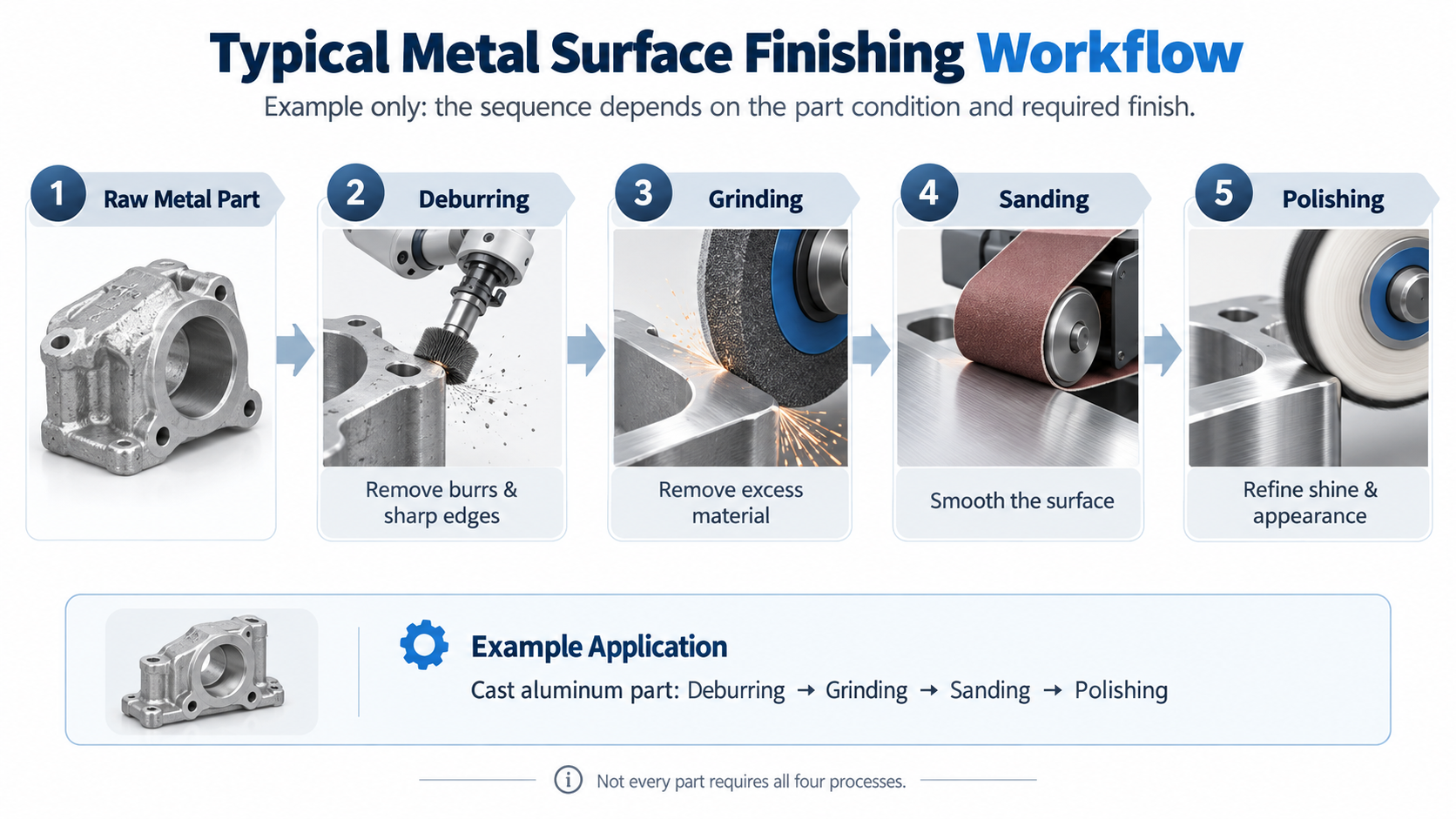
Typical Metal Surface Finishing Workflow
![4d166366-1cac-41a5-b741-035428173560]()
Example: Finishing a Metal Casting
For a cast aluminum component, deburring may first remove unwanted burrs and sharp edges. Grinding can then eliminate excess material or casting irregularities, followed by sanding to create a more consistent surface texture. If a decorative or high-gloss finish is required, polishing may be added as the final step.
Not every metal component requires all four operations. For example, a CNC-machined part may only need deburring, while a decorative stainless steel component may require sanding followed by polishing.
Common Applications in Metal Manufacturing
Grinding, sanding, polishing, and deburring are widely used in metal manufacturing to improve surface quality, remove machining defects, and prepare components for assembly or further finishing. Different industries require different surface finishing processes depending on the material, part geometry, and desired results.
Metal Castings and Die-Cast Parts
Aluminum and zinc die-cast components often require deburring to remove flash, sharp edges, and unwanted projections. Grinding may also be used to correct surface irregularities, while sanding prepares visible surfaces for subsequent finishing. These processes are commonly applied to cast housings, brackets, and industrial components.
Recommended Processes: Deburring, Grinding, Sanding
Automotive and Machinery Components
Automotive and machinery manufacturers use grinding and deburring to finish machined parts, remove sharp edges, and prepare components for assembly. Depending on the requirements, sanding or polishing may also be applied to improve surface consistency and appearance.
Recommended Processes: Grinding, Deburring, Polishing
Stainless Steel Products
Stainless steel products often require sanding and polishing to achieve consistent brushed, satin, or high-gloss finishes. These processes are commonly used for stainless steel tubes, hardware, kitchen equipment, and decorative metal components.
Recommended Processes: Sanding, Polishing
Metal Hardware and Fabricated Parts
Sheet metal parts, stamped components, and fabricated hardware may contain burrs, weld marks, or uneven surfaces after manufacturing. Deburring removes sharp edges, grinding reduces excess material, and sanding creates a more uniform surface before coating or assembly.
Recommended Processes: Deburring, Grinding, Sanding
How to Choose the Right Surface Finishing Machine
Choosing the right surface finishing machine depends on the workpiece material, part geometry, required surface quality, and production volume. Different machines are designed for material removal, surface smoothing, polishing, or burr removal.
The following guide helps manufacturers select suitable equipment for their metal finishing applications.
Surface Finishing Machine Selection Guide
Finishing Requirement | Recommended Equipment |
Remove excess material or uneven surfaces | Grinding Machine |
Smooth scratches and create uniform textures | Sanding Machine |
Achieve smooth or mirror-like finishes | Polishing Machine |
Remove sharp edges and machining burrs | Deburring Machine |
Process complex parts repeatedly | Robotic Finishing System |
Explore Surface Finishing Equipment
Grinding Machines
For material removal, weld grinding, and surface correction on metal components.
View Grinding Machines →

Polishing Machines
For refining metal surfaces and producing consistent satin or high-gloss finishes.
View Polishing Machines →

Deburring Machines
For removing unwanted burrs and sharp edges from cast, stamped, and machined parts.
View Deburring Machines →

What Should You Consider Before Choosing a Machine?
Before selecting equipment, manufacturers should evaluate the workpiece material, size, shape, required finish, and production capacity. For complex components or high-volume production, robotic grinding, polishing, or deburring systems may provide more consistent processing.
At Yatai, we offer automated metal finishing solutions for various industrial applications. Contact our team to discuss your workpiece requirements and suitable equipment options.
Production Efficiency and Cost Considerations
Production volume, processing time, labor requirements, and equipment maintenance costs should also be considered when selecting surface finishing equipment. For high-volume manufacturing, automated grinding, polishing, and deburring machines can help improve processing consistency and reduce manual work. The most cost-effective solution depends on the workpiece design, required finish, and production capacity.
Other Metal Surface Finishing Processes
Besides grinding, sanding, polishing, and deburring, manufacturers use several other surface finishing techniques to meet specific requirements for surface texture, dimensional accuracy, and edge quality.
The following processes are commonly used in metal manufacturing:
Process | Main Purpose | Common Applications |
Brushing | Creates a uniform, directional surface texture | Stainless steel panels, metal hardware |
Buffing | Improves surface shine using buffing wheels and compounds | Decorative metal parts, stainless steel products |
Lapping | Produces highly flat and smooth mating surfaces | Sealing surfaces, precision components |
Honing | Improves the geometry and surface finish of internal bores | Engine cylinders, hydraulic components |
Satin Finishing | Produces a soft, low-gloss surface appearance | Kitchen equipment, architectural hardware |
Chamfering | Creates beveled edges on workpieces | Machined parts, metal fittings |
Edge Rounding | Smooths sharp corners into rounded profiles | Sheet metal parts, stamped components |
While some of these techniques overlap with grinding, sanding, or polishing, each serves a specific finishing requirement. Manufacturers should select the appropriate process based on part geometry, surface specifications, and intended application.
Conclusion
Grinding, sanding, polishing, and deburring play different roles in metal surface finishing. Grinding removes excess material, sanding creates uniform surfaces, polishing improves surface appearance, and deburring eliminates unwanted burrs and sharp edges.
Choosing the right process depends on the workpiece material, surface requirements, and production needs. In many manufacturing applications, combining multiple finishing processes can help achieve better results.
Yatai Polishing Machine Co., Ltd. provides automated grinding, polishing, and deburring solutions for various metalworking applications. Whether you need to improve surface quality or streamline production, our team can help you select suitable finishing equipment.
Contact Yatai to discuss your metal surface finishing requirements.
FAQ
1. What Is the Difference Between Grinding and Sanding?
Grinding is primarily used to remove excess material, correct shapes, and eliminate significant surface irregularities. Sanding generally uses finer abrasives to smooth surfaces, reduce scratches, and create uniform textures. Grinding is often used for heavier material removal, while sanding focuses on surface preparation and finishing.
2. Is Sanding the Same as Polishing?
No. Sanding removes surface imperfections and creates a consistent texture, while polishing further refines the surface to achieve a smoother or glossier finish. Sanding is often performed before polishing, especially when processing stainless steel, aluminum, and other metal components.
3. Can Polishing Remove Grinding Marks?
Yes, polishing can reduce fine grinding marks, but deep scratches or rough grinding patterns usually require additional sanding before polishing. Manufacturers commonly use progressively finer abrasives to prepare metal surfaces before achieving the desired polished finish.
4. Should Deburring Be Done Before or After Polishing?
Deburring is generally performed before final polishing to remove sharp edges and unwanted burrs created during machining or cutting. However, the actual sequence depends on the workpiece geometry, material, and finishing requirements. Some automated systems can combine deburring and surface finishing operations.
5. What Is the Difference Between Deburring and Edge Rounding?
Deburring removes unwanted burrs and sharp projections left by manufacturing processes. Edge rounding intentionally creates a smooth, rounded edge profile. Although both processes improve edge quality, edge rounding may require additional material removal to achieve a specified radius.
6. How Do I Choose Between a Grinding Machine and a Polishing Machine?
Choose a grinding machine when your main goal is material removal, surface correction, or dimensional adjustment. A polishing machine is more suitable for improving smoothness, removing fine finishing marks, and achieving decorative surface finishes. The final selection should consider the workpiece material, required finish, and production volume.
7. What Is the Difference Between Grinding and Buffing?
Grinding primarily removes material to correct shapes, dimensions, or surface irregularities. Buffing uses soft wheels and polishing compounds to enhance surface smoothness and shine. Grinding is typically performed during earlier finishing stages, while buffing is often used near the end of the process to improve appearance.